
| Colonel
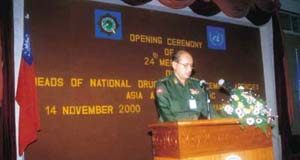
Tin Hlaing opens 24th Meeting of Heads of Law Enforcement Agencies of Asia-Pacific Region, HONLEA |
H.E.Colonel Tin Hlaing, Chairman
of the Central Committee for Drug Abuse Control and Minister for Home Affairs,
Union of Myanmar delivered the opening address at the 24th
Meeting of Heads of Law Enforcement Agencies of the Asia-Pacific Region on14
November 2000.
|
Excellencies Distinguished Delegates Representatives from UNDCP Ladies and Gentlemen |
|
At the outset,
on behalf of the Government of the Union of Myanmar and the Central Committee
for Drug Abuse Control, Ministry of Home Affairs, I have great pleasure in
extending a very warm welcome to you all.
As the Chairman
of the Central Committee for Drug Abuse Control of Myanmar and also in the
capacity of the Minister for Home Affairs, it is a privilege to be afforded with
the opportunity to deliver an opening address to this very important 24th
Meeting of the Heads of Law Enforcement Agencies of the Asia-Pacific Region,
organized by the UNDCP and hosted by the Union of Myanmar.
Excellencies
Distinguished
Delegates
The
international community is now fully aware of the problem of narcotic drugs and
the dangers that has been threatening the human society. The traffic of illicit
drugs, transcending international borders, has taken its rightful place to
become a major transnational crime.
As stated, the
illicit trafficking of drugs has also become the major transnational crime
committed in our region. The huge profits generated by the drug trade has
triggered incentives to drug traffickers that they do not heed anymore even to
the death penalties prescribed in national legislations for drug crimes.
Drug trafficking
crimes have not only seriously undermined the economy, political and social
fabrics, but also the stability of community peace and tranquillity and national
security of country states.
In this
connection, it is fitful that we welcome the initiative taken by all concerned
member states and the United Nations in drafting the UN Convention against
Transnational Crimes at Vienna, soon to be signed in December, 2000 at Palermo,
Italy.
Excellencies
Distinguished
Delegates
It is apparent
that the fight against drugs trafficking could neither be fought nor won by one
country alone nor by leaving out one country. Drug traffickers take footholds in
countries that lack or have weak anti-drug legislations, irrelevant enforcement
strategies and outdated interdiction tactics. They would then take full
advantage of these shortcomings to traffic drugs in and out of the country, thus
affecting and creating a threat to neighboring countries.
It is imperative
that one country should not be left out but all countries should stand together
based on mutual understanding, trust and cooperative spirit, to form a strong
and united front. This is why we are gathered here today.
There is no
question that UNDCP plays a key role in the combat against drugs. To this end,
we have witnessed the enhanced and effective efforts of UNDCP, particularly
during the tenure of UN Secretary-General Mr. Kofi Annan and Deputy
Secretary-General, Mr. Pino Arlacchi.
Drugs affect all
human lives, thus, each and every one of us has an obligation and responsibility
to fight against it. However, sad to say, it becomes blurred and out of focus
when efforts of individual countries are viewed and tainted with political
issues.
It is very
important that countries have a political will and a strong commitment to fight
and eliminate the scourge of drugs. Myanmar has been embarking on a 15 Year
Master Plan commencing 1999-2000 to totally eliminate drugs in the country by
2014. We are very much encouraged that ASEAN has set course on the same agenda
as Myanmar on its ASEAN Vision 2020 by reducing the target date to Drug Free
ASEAN 2015 at the ASEAN Ministerial Meeting at Bangkok in July this year.
Subsequently, last month in Bangkok, ASEAN and China agreed on a Drug Free ASEAN
2015 Plan of Action.
The Meeting here
today is a clear testimony and indication of participating countries of their
political will and commitment to cooperate with other countries in the fight
against drugs in the region. In this connection, I am sad to say that it left us
no choice but to assume that some responsible countries, which have decided to
boycott the meeting for various reasons, do not harbour sincere intentions for
cooperation with other countries and on the same time, have s blatantly ignored
an International Meeting organized by the UN.
I am not in a
position to say what their intentions are but whatever reasons they may have, we
have a clear conscience to work together with whoever who wants to work with us
and help us. To this end we have the doors wide open and stand ready to show our
efforts, our achievements as well as our shortcomings and to welcome the sincere
assistance and cooperation of the sinternational community.
Excellencies
Distinguished
Delegates
Myanmar has been
showing her political will and commitment to work together particularly with
neighboring countries in the region. Not only do we have bilateral agreements
with Vietnam, the Philippines and the Russian Federation as well as a Tripartite
Agreement with Laos and Thailand but also we are an active member of the 6
sub-regional countries MOU to control drugs with a balanced approach by
implementing supply and demand reduction and law enforcement projects of the
Sub-regional Action Plan. UNDCP has been assisting us with financial and
technical support with funding from donor countries.
Myanmar became a
full-fledged member of ASEAN in July 1997 and the Prime Minister; Senior General
Than Shwe briefed the ASEAN Summit on drug control endeavors of Myanmar. Mr.
Koffi Annan, UN Secretary General, attending the Summit Meeting was impressed
and subsequently dispatched an expert team in 1998 to draft a 10 year plan to
eradicate poppy cultivation and production in the whole country. UNDCP Executive
Director Mr. Pino Arlacchi also visited the border areas of Myanmar in the same
year and sanctioned a few small-scale projects.
I was informed
that the UNDCP drafted 10 Year Plan for Myanmar was prepared in time to be
submitted to the 1998 UN General Assembly Special Session on Narcotic Drugs.
Sadly, for reasons not stated, UNDCP was not in a position to submit the Plan to
the Special Session. However, I wish to express our gratitude to Mr. Arlacchi
for his keen interest and sincere efforts to help us.
As stated,
Myanmar has been implementing the 15 Year Plan since 1999. I believe that the
majority of the country representatives attending this meeting are much more
oriented with drug trafficking and drug abuse while Myanmar has to deal with the
problem of poppy cultivation and production also. The border areas that are
engaged in poppy cultivation and production were once under the dominance of
insurgents and due to this fact, these regions have been left out of the
mainstream of the country, lagging behind in terms of development, depending
their livelihood on the income from opium poppy.
The government
now has entered into peace agreements with the insurgent groups, opening up
opportunities for all-round-development programmes in these regions. With the
guidance of the Prime Minister himself, border area development projects were
drawn up and a separate Ministry was established to take care of these problems
in a holistic way.
The 15 Year Plan
calls for the gradual elimination of poppy cultivation and production in these
areas supplemented with demand elimination, law enforcement, participation of
the local inhabitants and international cooperation programmes. In this regard,
I sincerely hope that we will have the understanding of the international
community on the complexity of the drug problem and what we have gone through
and our efforts at present to overcome this menace.
The national
races who have been engaged in poppy cultivation for centuries realized the drug
menace and threat to mankind and embraced the policy and strategy laid down by
the government. They have voluntarily promised and declared for the
establishment of opium free zones with phased programmes of their own. The
establishment of the Opium Free Zone in Mong La, in the eastern Shan State in
1997 stands testimony of this success.
Of course, these
changes cannot take place overnight. The distinguished delegates will understand
and realize that it is easier said than done.
Excellencies
Distinguished
Delegates
Just when we are
starting to see hope in the elimination of poppy cultivation and production with
annual decreasing figures, the problem of stimulants has suddenly taken the
stage.
Researchers have
discovered stimulants over a century ago for licit use but it has become to be
an abuse problem in the region just a decade ago. Myanmar faced the problem
starting only in 1996 when we made the first seizure of stimulants.
Starting raw
materials, precursor chemicals are not produced in Myanmar in addition to the
lack of laboratory expertise and financing to produce these drugs. Thus, it
clearly indicates that foreign drug syndicates are exploiting the long, remote
and porous border situation to produce these stimulants on the border area. We
are sceptical that the problem of stimulants has been intentionally created when
the glimmer of hope and possibility is at hand in the total eradication and
production of opium within a few years.
In addition, the
drug trend has been changing with the life styles of youth where freedom and
personal rights to enjoy the pleasures of nightlife are permitted to stretch to
the maximum and beyond limits. It is one of the reasons why it was rightfully
predicted and identified at the UNDCP organized Shanghai International Expert
Meeting on Stimulants in 1996, that stimulants abuse will be the major drug
problem for the 21st century.
Excellencies
Distinguished
Delegates
We have a saying
in Myanmar that if we know the illness, there is always a medicine to cure it.
In other words, ” if there is a will, there is a way “. It is a
glaring fact that the world is facing a drug problem. Mobilizing the full
awareness and participation of the public, every country should do their utmost
to get rid of it. However, if we do not cure or take measures with the medicine
called ” international cooperation “, the illness will be like a
cancer spreading and eating away the social fabrics of the human society.
There have been
numerous crimes of enormous proportions that the evils of drugs have created,
even undermining the peace and stability of country states. Money laundered from
proceeds of drug trafficking has destroyed the economies of countries. HIV/ AIDS
epidemics are also offspring of drug abuse. The dangers and threat of drugs are
not contained and limited to one area, region or state and have no
discrimination on developed or developing or undeveloped countries. This is the
sole reason that the international community needs to stand together and
cooperate to fight the menace of drugs.
Excellencies
Distinguished
Delegates
In conclusion,
the 24th Meeting of HONLEA will be discussing practical
issues and problems on law enforcement in the region to find ways and means on
better cooperation between state governments and UNDCP. It will also review the
implementation of decisions taken at the 22nd HONLEA.
I fully believe
that participating countries including Myanmar will benefit a lot in the coming
4 days, from the discussions based on national experience and information
sharing on illicit heroin trafficking and abuse, electronic crimes or cyber
crimes affecting drug trafficking strategy, maritime drug trafficking and
control of stimulants.
I wish to
sincerely urge all delegates to discuss frankly and openly and to share
experiences on a friendly atmosphere to find better ways and means for practical
cooperation. I also urge UNDCP to assist us to realize our common goals in the
region.
I thank the
participating countries and UNDCP for their support and decision providing the
opportunity to Myanmar to host this HONLEA Meeting in Yangon. I thank each and
every one of you who have contributed to make this meeting a success and I thank
Your Excellencies and specially invited guests for taking out time from your
busy schedules to grace this Opening Ceremony.
Thank you.
_________________________________________