
4th Destruction of Narcotic
Drugs Ceremony – 1st July 1991
Participants:
- Secretary-1 of the State Law
and Order Restoration Council and members - Resident Representatives of UN
agencies - Diplomats and Military
Attaches - Representatives of the UN Drug
Control Programme and Drug Control Division - Foreign Media Personnel
- Local Media Personnel
- Department Heads and Invited
Guest
Report made by the Central Committee for Drug Abuse
ControlStatement given by joint
secretary of the central committee for drug abuse control, pol. Col ngwe soe
tun at the ceremony on destruction of narcotic drugs, seized by law
enforcement agencies on 1st July 1991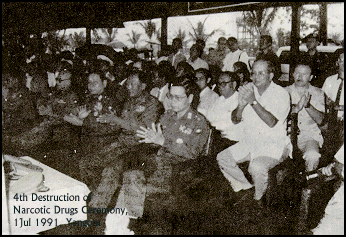
Chairman of the Central
Committee for Drug Abuse Control, Secretary-1 and Members of the State Law
and Order Restoration Council, Resident Representatives from the United
Nations Organizations in Myanmar, Diplomats and Military Attaches in Yangon,
Local and Foreign Journalists, Department Heads and Invited Guest,The objective of the Fourth
Destruction of Narcotic Drugs Seized by Law Enforcement Agencies, convened
today, is the commemoration of the International Day Against Drug Abuse and
Illicit Trafficking. On behalf of the Central Committee for Drug Abuse
Control, I would like to extend my profound gratitude for your presence on
this occasion.Today, I am presenting two
portions. First of all, I would like to include some significant endeavours
to fight against narcotic drugs during the period 18th. of September 1988 to
now.Regarding the reconstruction
of the lives of poppy growers in order to give up poppy growing, the
Chairman of the State Law and Order Restoration Council made a remark which
can be used as drug control policy as follows;“We must implement
long-term and short-term projects. As a short-term project, cash crop should
be introduced to them for their subsistence, while long-term project should
include substitution of perennial crops, together with the social
infrastructure development measures. Communication, education and
dissemination of information will be also needed. We should upgrade living
standard.”In accordance with this
policy, income substitution activities such as annual and perennial crops
replacement and livestock breeding, treatment, rehabilitation, upgrading
social conditions, education and media network are being carried out by the
respective sectors, for the progress of the living standard of poppy
farmers.Your Excellencies and Invited
Guests,The Border Areas and National
Races Development Central Committee has been constituted on 25th. of May
1989. Since then, border areas and national races development projects have
been implemented in five States and one Division and will be extended in the
other border areas. “With the development of border areas, poppy
growing will be eliminated.” At the same time, in line with this aim,
the anti-drug measures are being taken with the border areas and national
races development programmes and would contribute towards the total
eradication of poppy cultivation in border areas. As results of these two
parallel projects, the local people in Kokang, Mongko regions and Mongla
region in east of Kyaington area started giving up poppy cultivation and
poppy refining gradually. You are aware of the fact that insurgent groups in
those areas returning to the legal fold and are cooperating with us for the
development of their border areas and the elimination of drug menace. In
this respect, I am disappointed with a false news, carried recently by a
foreign newspaper. It mentioned that we have planned to destroy over 20
thousand acres of poppy fields annually in Kokang region without providing
anything to the poppy farmers for their sustenance and they, therefore, fled
to other country. Actually, border areas and national races development
programme has been introduced in Kokang region.Setting up villages and towns
road construction, opening of schools, hospitals and dispensaries, electric
power supply, land development and provision of seeds, seedlings,
fertilizers and agro-techinques through existing base and forward stations
are being carried out by investing 52.23 million kyats. After the
destruction of 1,500 acres of poppy fields by national races, on their own
will in Nyophynsapar, Kokang region, a total of 3,500 bags of rice has been
distributed immediately to the poppy farmers. Local and foreign journalists
were present on that occasion and gathered the news and have disseminated
that news to their agencies.Your Excellencies and Invited
Guests,Altogether 16 representatives
from the 8 United Nations agencies made a study tour to Kokang, Wa regions
and Mongla in east of Kyaington area for two weeks in March 1991. They held
frank discussion with the national races, in poppy growing areas. Evaluating
on that study-tour, they are now preparing necessities for the supportive
action.Your Excellencies and Invited
Guests,A firm resolution calling for
the community to stop illicit production, trafficking and abuse of narcotic
drugs through international or regional or sub-regional co-operation,
instead of taking national drug control measures, was passed by the 17th/
Special Session on Narcotic Drugs of United Nations General Assembly held in
New York in February 1990 and World Ministerial Summit to Reduce Demand for
Drug and to Combat Cocaine Threat held in London in April of the same year.
In line with this resolution, Myanmar has entered into co-operation with her
neighbours — People’s Republic of China and Thailand. Such co-operation
projects will soon be initiated. There are three main objectives in
combating narcotic drugs in co-operation with neighbouring countries. They
are;1. to reduce trafficking in
narcotic drugs and chemicals used in refining of heroin across the China/
Myanmar. Thai/ Myanmar borders.2. to eliminate opium poppy
cultivation in the areas adjacent to the borders through economic and social
development programmes linked to phased eradication,3. to reduce the demand for
the local consumption of narcotic drugs in the areas along China/ Myanmar
and Thai/ Myanmar borders.The detail measures will be
carried out as soon as the projects begin.Your Excellencies and Invited
Guests,The significant fact. I would
like to mention, in wiping out drug menace, is that Myanmar has now
deposited the Instrument of Accession to the 1988 United Nations Convention
Against Illicit Traffic in Narcotic Drugs and Psychotropic Substances with
the Secretary-General of the United Nations on 11 June 1991. It is one of
the historic events in our drug control efforts. Formerly, some of the
countries misunderstood us as we have not made accession or ratification to
that International Convention. Now, it Provides for our endeavours in the
fight against narcotic drugs and we can stand firmly and brilliantly among
the international community without being blamed or misunderstood on us by
those countries. Relating this matter, press conference has been held by the
respective authorities. For your reference, statement by H.E. U Ohn Gyaw
Deputy Minister for Foreign Affairs, on that occasion, is included in the
booklets distributed to you.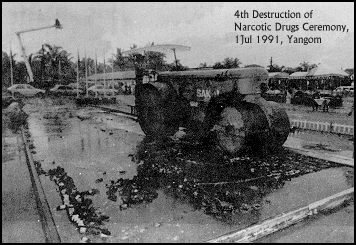
Your Excellencies and Invited
Guests,Law enforcement activities
such as seizures of narcotic drugs and destruction etc. are shown in the
exhibition hall with photographs, slides and graphs and also in your
booklets.Your Excellencies and Invited
Guests,The second part deals with
the destruction of narcotic drugs which could be classified in two types.The first type is that the
narcotic drugs seized by Law Enforcement Agencies such as Tatmadaw (Armed
Forces), People’s Police Force, Customs and others are deposited to the
Criminal Investigation Department, after the trial. Among them, heroin,
morphine, opium oil, liquid opium, tablets and liquid are destroyed as
permitted. Up to now, it has been held for three times and destruction of
drugs value at US $ 1,319 million.The other is supply reduction
activity to reduce cultivation and production of narcotics. National races,
on their own will, have destroyed poppy fields, refineries, heroin,
chemicals, paraphernalia and huts in poppy suitivated and opium produced
areas. Such type of destruction has been carried out for one time in 1990 —
in Laukkai, Kokang region — and for two times in 1991. — in Mongko
region and Mongla region. National project —– Border Areas and National
Races Development Programme —- has been implemented in these regions and
necessary assistance will be provided to them by the international
organizations through the United Nations.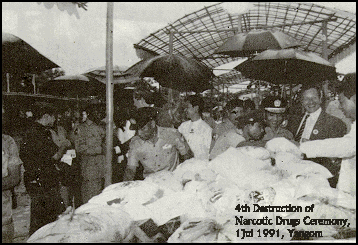
drugsThe drugs to be destroyed for
the fourth time today are;Heroin – 76,355 kilograms
Morphine – 28,965 kilograms
Opium Oil – 1,542 kilograms
Liquid Opium – 6,726 kilograms
Marijuana – 377,789 kilograms and
Phensedyl – 2,266,750 kilogramswhich value at US$ 192
million (in Myanmar currency kyats 1,206 million.Your Excellencies and Invited
Guests,Narcotic drugs which have
been destroyed for three times value at US$ 1,319 million and if the value
of narcotic drugs to be destroyed today includes, it will be US$ 1,511
million while drugs, refineries, chemicals and poppy fields reduced in
supply reduction activities in border areas value at US$ 2,819 million.
Thus, the total value is US$ 4,330 million. Such amount of narcotic drugs
destroyed by us could not be calculated by only money value, but it should
be compared with the lives, blood and time, money, medicines, techniques and
agonies of the relatives of those who cultivate, produce and traffic
narcotics and those of addicts including those suffered by the State. Here,
you would find the scourge of narcotic drugs as frightful and disgusting
scence. Therefore, please compare measure for control of drugs with valuable
lives of the human beings rather than its value.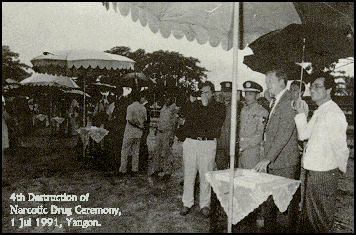
drug
Your Excellencies and Invited
Guests,As stated in the Motto,
“Let’s Join Hands in
the Fight Against Narcotic Drugs — the Menace of Mankind,”I would like to urge the
world community to participate in solving the drug problem not only as a
national duty but also as an international cause.Thank you very much.