|
Why Did U Khun Sa’s MTA Exchange Arms for Peace |
|
Part III I was not involved in anyway nor did I have any official responsibility regarding the MTA’s exchange of arms for peace. Nevertheless I was very much interested and it was worth the interest. Because never before had there been such a historically momentous event. This interest made me bring up this topic for discussions with my friend every time we met. “How goes it my friend? I believe you went to Ka Thai Kwin yesterday. How is your agriculture project faring?” “It’s doing well. Departmental officials are giving all necessary assistance. But you must understand this is an entirely new beginning for our MTA members. They don’t have much experience.” “Oh! I’m glad. The cottages built by the Government look inviting too. You have adequate water and electricity supply and have been given 4 to 5 acre plots of land for cultivation. The land has already been ploughed for you, seeds have been made available and you have been provided with cash to defray the cost of cultivation. In addition you’ve been given living expenses to tide you over before the first crop can be harvested. What more do you need?” “The Government is doing all it can, not just for regional development. It’s doing everything within its means to provide life’s necessities, food, clothing and shelter for those who have made peace agreements as well as for those who have chosen to exchange arms for peace.” “As I’ve already told you, because the Government’s peace initiatives were correct and there was good will, the people’s desire for peace swelled and overwhelmed all parts of the country. Didn’t I tell you that this development played a principal role in the MTA’s decision to exchange arms for peace? “Yes you did. Now tell me how widespread and effective was this surge for the desire for peace.” “Beginning from the peace achieved in 1989 with the Kokang group which had split from the BCP, other armed groups followed suit one after another. Finally, most of the armed groups in the vicinity of the MTA had all accepted the peace pact. Isn’t that so? So this led to a situation where the people inhabiting the region didn’t want to hear the sound of guns any longer. They too started to long for peace. Then the idea of peace seeped into the minds of our MTA members. They also saw with their own eyes, members of armed groups who had made peace, going about their business freely. So, I suppose, they began to question why they were still continuing the fight and wonder why they too couldn’t be in the same situation. Once these thoughts had entered their heads some sort of transformation set in. I believe their will to fight had somewhat lessened.”
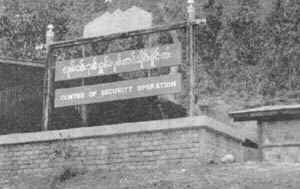
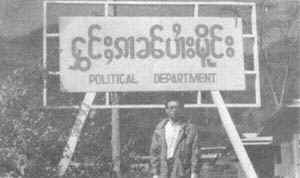
The premises and signboards of offices. “That’s possible. It’s human nature. “ “So at a time when the others had achieved peace and were now leading untroubled lives, U Khun Sa miscalculated and made a decision that was a crucial mistake from the military point of view.” “Do you mean the attack launched on Government military forces in the Mongkyut region that you mentioned earlier on?” “Yes of course ! That Peter Bourne, you know, the former advisor to American President Carter was mainly responsible. U Khun Sa made the decision to attack at his instigation.” “Are you certain it was at Peter Bourne’s instigation?” “Look my friend. Don’t forget I was a member of the Central Committee, so there are certain things I know not known to others in general. Although U Khun Sa was declared a wanted criminal on narcotic drug charges by the U.S Government in 1990, there were many Americans frequenting our headquarters. Peter Bourne’s visit of course was more significant. The Bangkok Post even quoted him as saying that Khun Sa had the necessary force in both men and arms to set up an independent Shan State. In fact, it was none other but Peter Bourne who had urged U Khun Sa to adopt this political stance and fight the Government to overcome his notoriety as a drug war lord and simultaneously gain international recognition.” “These westerns are truly unprincipled and devious scoundrels. So what happened when the attacks were launched?” “It’s as I told you. There had been small, unnoticeable changes in the attitude of our men. This Mongkyut offensive was one we had launched. But it was a battle that shouldn’t have been undertaken at all. The number of dead and wounded was much more than bargained for. “
Classrooms at Ho Mong. “I read about it in the newspapers that it was a fierce battle with heavy casualties on both sides. I remember that much.” “Believe me the casualties exceeded the numbers mentioned in the papers. The MTA forces deployed totaled about S,000. The attacks and counterattacks lasted over a month from 11th May to 23rd June 1994. Over 800 of our troops were killed in action and about 1,000 were wounded.” “Huh, that’s a lot! “ “That’s what I meant when I said he had miscalculated and committed a grave military error that was also meaningless. In 1995 we had to continue the fight in the Hpet Tu Mein region that resulted in about 300 more being killed and about 400 wounded. I am mentioning only the more conspicuous clashes. It doesn’t include the dead or wounded in the small daily skirmishes with Government Forces scattered all over the region.” “Well, you people were still in the thick of fighting at a time when others had made peace and were leading a tranquil life. “ “We were fighting not only Government troops. In the Lwe Lan region we often clashed with the ‘ Wa ‘ group up to the time we exchanged arms for peace. During the 6 years that we fought with the ‘ Wa ‘ forces over 1300 of our men were killed and I believe not less than 1500 were wounded.” “Such a large number of casualties must have resulted in loss of morale. ” “It certainly did. I did say that defeat in battle was not one of the principle factors that led to U Khun Sa’s surrender but at the same time, the prospects for future military action were not encouraging. U Khun Sa must have foreseen that if we went ahead as we had been doing, the situation would only have gone from bad to worse.” “I don’t understand much about military affairs. But the Government’s peace initiatives were so effective and successful, the only enemy left in the Shan State was your group. So my comrade, I think the Government Forces could have finished you off in no time. ” “If it meant carrying on the fight to the bitter end, then there would have been more dead and wounded. It was quite obvious by that time that the Government Forces now had the upper hand. I’ll give you an example. If there had been a plan to attack our headquarters at Ho Mong previously, it would not have been an easy matter. But by 1995, armed groups in the Kayah State had made peace, so it would have been easy to launch an attack from the Kayah State. On the Shan-Kayah border too, the Pa O group had made peace. So the Government troops could have easily entered our headquarters from this direction also. The Government troops could make an approach from Mong Kyut too, since they already had the upper hand in the region. They could have blocked movements of our troops on the west bank of the Thanlwin at any point along the river. Under these unfavourable conditions our headquarters would have fallen easily into Government hands. So from a military standpoint the conditions prevalent at the time would have led only to our downfall. Then the defection of the Shan group made the situation worse and put us in a more vulnerable position.” “Oh! That reminds me. I asked you the other day the reasons for the defection of the Shans. Can you tell me more about that?” “To understand the reasons for their defection you’ll need to know a little of the background history. You’ll first need to know how the Shan group joined U Khun Sa’s Lwe Maw Group. To make it brief, when U Khun Sa was released from prison under the General Amnesty in 1976, he arrived at the Thai border where the underground Lwe Maw group was based. After his arrival this underground group was reorganized as the Shan United Army (SUA) After attacking the small remnant KMT Chinese encamped in this area, they managed to gain a foothold. In the same way, they attacked the ‘Wa’ (WNA) in the Mai Aw region and gained control of more territory. This was how it became stronger. He also managed to persuade the Shan. United Revolutionary Army (SURE) led by Moe Hein to join him. This led to the formation of the Mong Tai Army (MTA). In 1990, he persuaded another Shan group, the Shan State Army (SSA ) led by Naw Mein Gyi to join forces. So by combining the forces of the original Lwe Maw Group, the SURE and the SSA, the MTA grew in military strength. It was a large armed group composed of a number of different factions. This, as you know, is a potential cause for future disagreement and disintegration.” “Wasn’t it a voluntary alliance made with the agreement of all concerned?” “Well you know what this involves. There are always those in favour of joining forces and those who were obliged to join due to various circumstances. Although they had joined forces each group had its own national outlook and political ideology. The number of Sino – Shans in the MTA was not large. Most members were pure Shan like me, say about 90% of the MTA members.” “As far as I know your MTA slogan is in the cause of a Shan State and the Shan people.” “The slogan is just that, a slogan. But there had always been basic underlying differences. Added to the political and ideological differences, there was also a certain feeling of racial discontent among the Shans.” “But you Shans were in the majority.” “The Shans were not given key positions and key posts. Any post given to a Shan was more as less nominal. The Shans began to feel that all the ranking jobs went to the members of the Lwe Maw. You see, from the beginning there was mistrust between the Lwe Maw and the Shans and that could have been why the Shans were not given important posts. The key posts all went to the Sino – Shans. The punishment meted out to the MTA members was also not the same. Furthermore only Shans were conscripted as soldiers and only Shan villages were singled out for robbing and killing and torture. Seeing all this, resentment started to simmer among the Shans. In the end they started to brood about all this and arrived at the conclusion that the MTA had done nothing to promote the Shan national cause. That all they would be left with was the notoriety of being members of an infamous drug trafficking gang, with nothing to show but Shan lives sacrificed in the interest of Sino-Shans.” “Talking about drug trafficking, how much money did you, my friend, manage to save?” “Don’t joke about this. I have yet to see even a grain of heroin. The people in charge of this heroin trade do not include even a single Shan. So now you should understand” “But you are a Shan yourself. So I must ask you not to exaggerate in favour of the Shans.” “This is not an exaggeration. It’s the actual truth. All this discontent and resentment finally led to the defection of political commissar of No. 16 Brigade Kan Ywet with a force of about 200 men in June, 1995.” “I heard about this. I heard that the MTA gave chase to attack this splinter group. I also heard that another commanding officer about to defect was caught and executed.” “Yes, after that the divisiveness became worse.” “At the time Kan Ywet also issued an announcement and distributed it to the villages in the region.” “Yes. The announcement included statements that the Shan State National Army (SSNA) had been formed and that his group would establish peace and work for regional development. He called on all Shan nationals to join their group. The announcement was written in both Myanmar and Shan. Not long afterwards, many Shan members left the MTA to join him, so much so that the strength of the SSNA grew to nearly 3,000. U Khun Sa had to really make an effort to prevent further defection and the collapse of the MTA.’ “Well it happens! look at the KNU. The Democratic Kayin Buddhist Associatiol1 (DKBA) members left the KNU in droves.” “After all this, suspicion filled the air. No one could trust any other. And on top of all this, the groups that had defected turned on the MTA and attacked it in some areas. The problems were thus compounded and there was a lot of confusion.” “Naturally on the one hand the military prospects were not bright, having suffered severe losses, and on the other hand there was this internal disintegration. It must have been a real predicament.” “As I told you from the beginning, after the State Law and Order Restoration Council assumed State responsibilities U Khun Sa’s mental attitude and convictions started to waver. Then the advent of your Government’s political policy that led to the peace initiatives plus the military superiority made him weaken so much in his resolve that he nearly toppled then. But the last straw that broke the camel’s bock so to speak was the wholesale defection of the Shan members of his MTA. I think by now you will have fully grasped the many factors that made U Khun Sa decide to exchange arms for peace. It’s enough for to day my friend. Time to rest.” “You always stop when it begins to get really exciting and interesting. I’m eager to know how this exchange of arms for peace was brought about. ” “I’ll continue later when we have the time.” |